
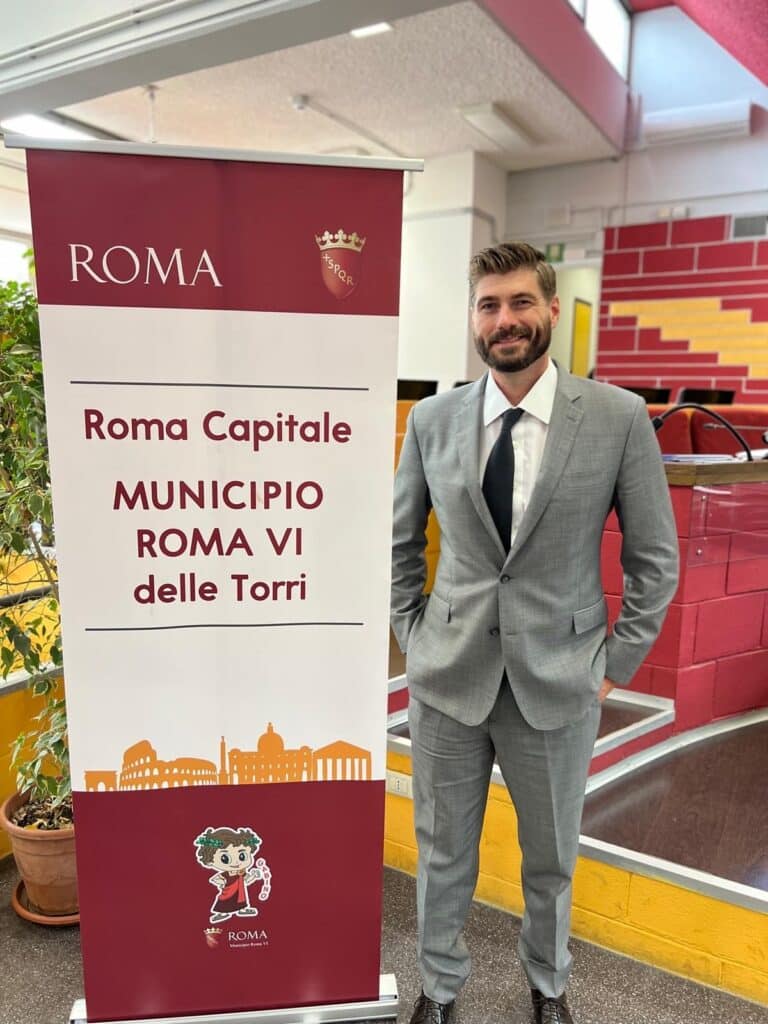

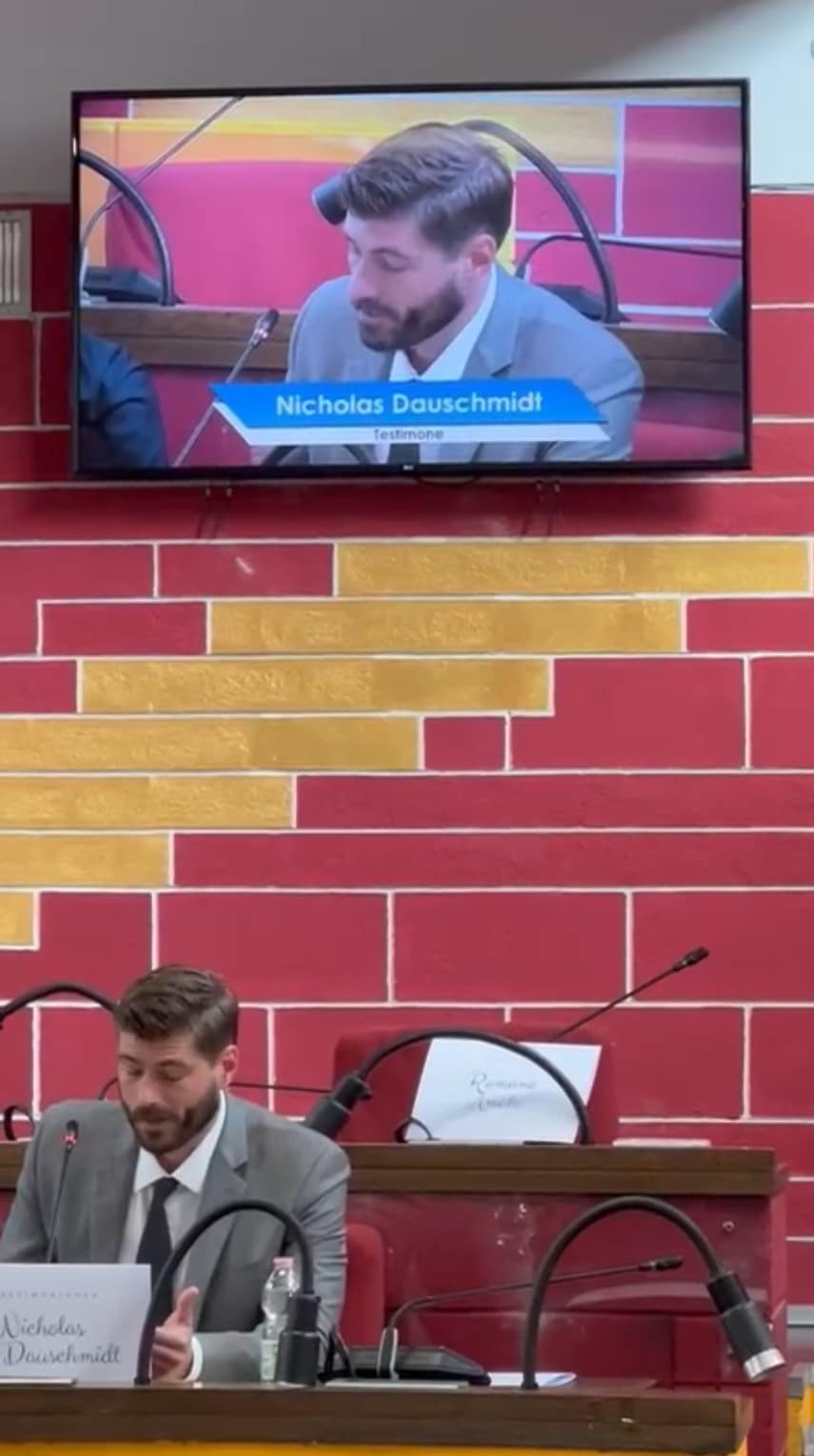
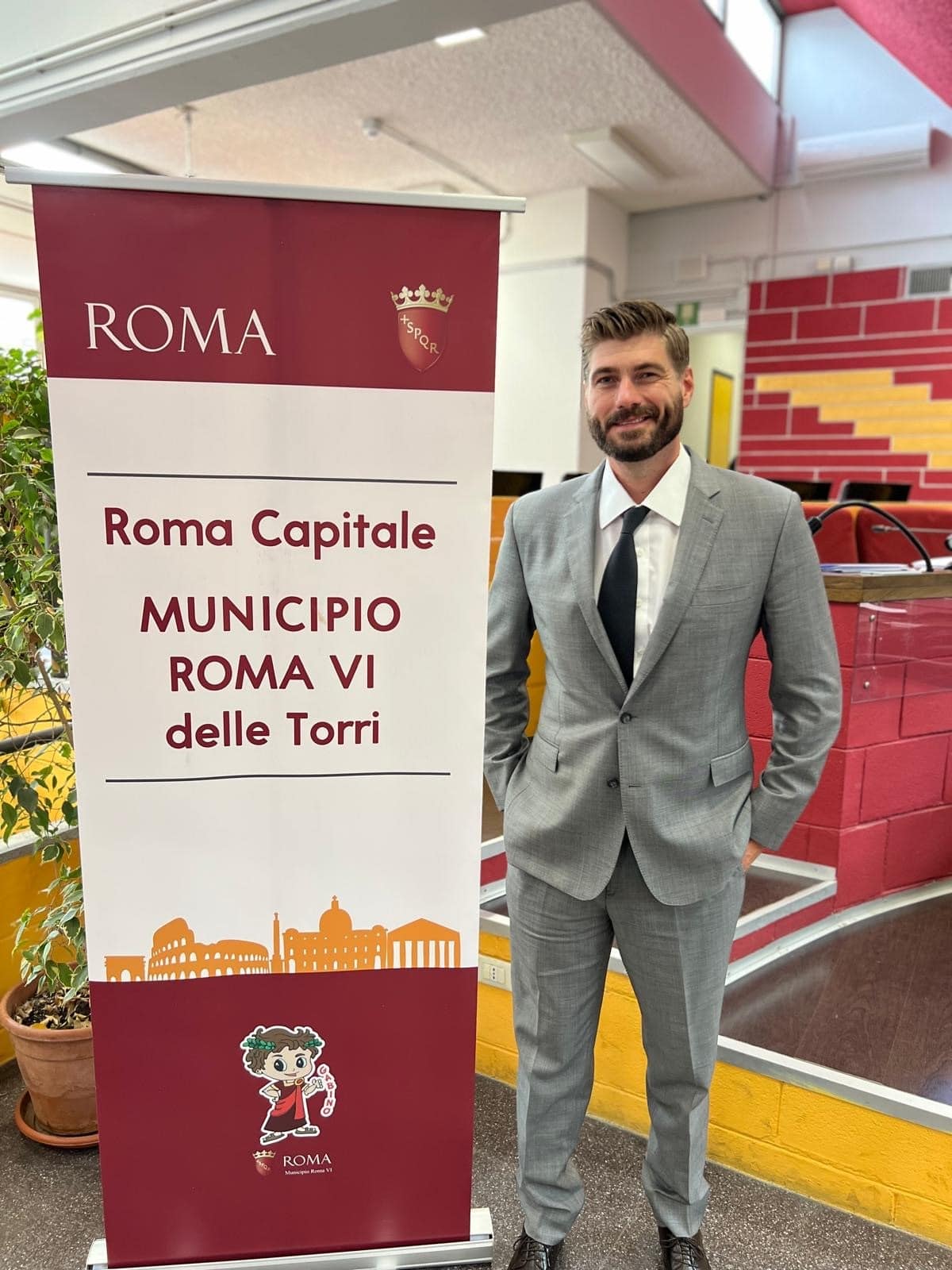
On October 17, 2025, court-martial defense attorney Nicholas “Nick” DauSchmidt addressed an audience inside Rome’s municipal chambers at a conference hosted by the Lega Uomini Vittime di Violenza (LUVV)—an Italian organization that advocates for male victims of violence. The event drew senators, judges, psychologists, family-law practitioners, and fathers whose children had been abducted across borders. It featured speakers who were professionals and subject matter experts as well as fathers who had personally experienced parental child abduction. Invited by LUVV after extensive Italian media attention, Attorney DauSchmidt bridged the speaker gap as both a professional and as a father with lived experience. The event highlighted the unique challenges Service-Members face while serving overseas, as well as the exceptional skillset offered by the Jordan UCMJ Law Group.
Attorney DauSchmidt delivered his fifteen-minute address entirely in Italian, sharing both his personal experience and his legal analysis of one of the hardest problems in international family law: the gap between what treaties promise and what governments actually enforce. Of particular note was DauSchmidt’s focus on U.S. Service-Members in Europe and the unique struggle they face when confronted with UCMJ jurisdiction, local European jurisdiction, and the intersection of these systems while in a quasi-resident status stationed abroad.
From Soldier to Left-Behind Parent
DauSchmidt’s story spans five countries and more than three years—a collision of military duty, family breakdown, and bureaucratic paralysis. In 2023, while stationed in Vicenza, Italy, his then-spouse took their six-year-old son’s passports and, through local Italian counsel, sought sole custody accompanied by fabricated allegations of violence and abuse. The child was born at Fort Polk, Louisiana, has dual American-Romanian citizenship, and was in Italy solely due to military orders as a dependent child.
There was no evidence, but institutional fear of scandal overrode due process. Before even investigating, his command suspended his parental contact with a military protective order, and when DauSchmidt legally recovered one of his son’s passports, the commander confiscated it and—without legal justification—gave it to the mother. One year later, the mother would take this passport with her when she abducted the child to Romania. For months, DauSchmidt’s son lived less than a kilometer away, yet he was forbidden to see him by his command.
“I realized that every institution involved—American, Italian, or otherwise—had a win-win situation,” he recalled. “If I gave up or took my own life, the problem disappeared; if I endured, the Army got its Soldier, the state its taxes, and my ex-wife her exorbitant monthly payments. All the while my son was the hostage. They will try and push you until you break.”
With the help of Italian attorney, Alexandra Harbeson, DauSchmidt began to fight back. A court-appointed forensic psychologist documented the truth and described the mother’s behavior as pathological. Seeing that DauSchmidt would not give up and the truth was being revealed, DauSchmidt’s ex-wife fled Italy for Romania in June 2024—an act that violated multiple court orders.
Romania, though a signatory to the Hague Convention on the Civil Aspects of International Child Abduction (1980), does not enforce return orders in practice. Even in the best-case scenario, countries like Romania consider “enforcement” to be achieved through only a monetary fine on the party that illegally took the child. Police will never go and retrieve one’s child, even if the law is enforced properly.
Back in Italy, the court dutifully granted DauSchmidt sole custody of his son after the abduction, but the order was without teeth. DauSchmidt requested assistance from the appropriate institutions in all countries involved, however: “the Army, the embassies, the Italian and Romanian police did not lift a finger,” he told the audience. “The U.S. State Department called my son and me ‘an Italian-Romanian problem.’” Being subject to the UCMJ and his command had harmed DauSchmidt’s situation—preventing him from seeing his son, confiscating a passport from him despite having joint custody, and ordering he pay additional money to his ex-wife—but the same powers would not assist in getting his military dependent son back from abduction.
So DauSchmidt did what many parents imagine but few attempt: he acted.
Operation Gardaland
With a small team that included a private investigator, his flight instructor, and a fellow veteran of the British Army, DauSchmidt launched Operation Gardaland—named for the amusement park he had promised his son that summer. Through legal counsel, surveillance, and meticulous logistics, he located his son and personally retrieved him from Romania. The final leg of the operation involved a four-seat Piper PA-28 departing from an abandoned Soviet airfield in northern Bulgaria.
Fifty-three days after the abduction, father and son were back in Italy—only to be taken into custody upon landing. Ironically, no law enforcement authorities had lifted a finger when the child was taken, but a continent-wide alert and manhunt was triggered when the lawful custodian brought the child home. The pair were released that same night, and months later, the Court of Vicenza confirmed DauSchmidt’s sole custody, explicitly recognizing Operation Gardaland as legitimate. The law reached the right conclusion in the end, but did nothing to achieve the actual outcome.
The Rome audience—many themselves entangled in Italy’s family-court labyrinth—listened in silence as DauSchmidt described the paradox: when institutions abdicate their responsibilities, the parent must assume them. “During this odyssey, I had to be everything the State refused to be: social support system for the mother, police officer, diplomat, rescue team—and, at the same time, a loving father.”
His conclusion drew quiet nods around the hall: “When the law is not enforced, justice becomes a matter of logistics and courage.”
DauSchmidt’s legal argument built on his lived experience. The Hague Convention, he explained, is only as effective as its enforcement mechanisms. As it stands, abducting parents from noncompliant countries face little in the way of deterrence. In fact, surveillance gathered during Operation Gardaland indicated that DauSchmidt’s ex-wife knew exactly what she was doing, how to “invert” the Hague jurisdiction, and was attempting to use the law as a shield for her actions. He urged European lawmakers to impose real consequences—financial, diplomatic, or judicial—on states that fail to return abducted children promptly and with physical law enforcement action as an end result for noncompliance.
He also pressed for better coordination among private-sector professionals until governments do their part. “Lawyers, investigators, and security experts must act together, within the law, to make the system work in reality, not just in theory,” he said. “Institutions produce rules; people produce miracles.”
The Service-Member’s Dilemma
DauSchmidt’s case highlights a larger issue for the thousands of U.S. service members and dependents stationed across Europe under the NATO Status of Forces Agreement. Frequent relocations, dual jurisdictions, and commands’ tendency to cater to accusers make them particularly vulnerable when family disputes cross borders.
Through his work with the Jordan UCMJ Law Group, DauSchmidt now represents Service-Members facing criminal and family-law crises overseas. The firm helps bridge the divide between U.S. military law and European civil systems, coordinating with local counsel, interpreters, and investigators to protect American rights abroad.
“Our Soldiers swear an oath to uphold and defend the Constitution—not to forfeit their children.”
From Personal Crisis to Professional Mission
What began as a deeply personal ordeal has become DauSchmidt’s professional mission. His Rome speech resonated not because of its drama, but because it translated pain into policy: a blueprint for how private citizens and practitioners can uphold justice where governments falter. DauSchmidt’s story provides a real-life example of the gaping hole between law and reality, especially as it applies to Service-Members stationed in Europe.
DauSchmidt has since assisted other left-behind parents—both Americans and Europeans—navigating the overlapping bureaucracies of EU states and the United States. His practice focuses on military criminal defense, child-abduction scenarios under the Hague Convention, and the unique challenges facing U.S. military families in Europe.
“The system is designed to provoke you into mistakes,” he said. “You need discipline, creativity, and the right team of people. But if you keep breathing and fighting, the truth eventually stands.”
To Survive Is to Win
DauSchmidt closed his testimony in Rome with a message that transcended legal theory: perseverance. “To survive is to win,” he said. “Every day you hold out reveals a little more of the truth. The State won’t save you—but another father might.”
The Broader Mission in Europe
For the Jordan UCMJ Law Group, DauSchmidt’s appearance in Rome underscores the firm’s growing presence in Europe and its readiness to act where American and European legal systems intersect. The practice handles UCMJ defense, VA disability matters, and legal issues facing Service-Members—including emergency interventions for abducted or endangered children.
With a network that spans the continent, the firm offers something few legal practices can: American boots-on-the-ground capability combined with foreign legal assets. As DauSchmidt put it afterward, “We’re not just familiar with Europe—we’re embedded here. When a U.S. Service-Member faces legal peril abroad, we can respond immediately, in the language, in the jurisdiction, and in the fight.”
About Attorney Nicholas C. DauSchmidt
Nicholas “Nick” DauSchmidt is an American licensed attorney (Indiana bar) and former active-duty U.S. Army Judge Advocate (JAG) now serving in the Army Reserve. Based in northern Italy, he represents U.S. Service-Members and government civilian employees in criminal defense, administrative matters, labor and employment law concerns, and international family law. He serves as Of Counsel to the Joseph Jordan UCMJ Law Group, a firm dedicated to defending and advising U.S. Service-Members worldwide.